Showing posts with label classical portrait. Show all posts

Friday, April 22, 2011

Portrait Theory: Single Light #2


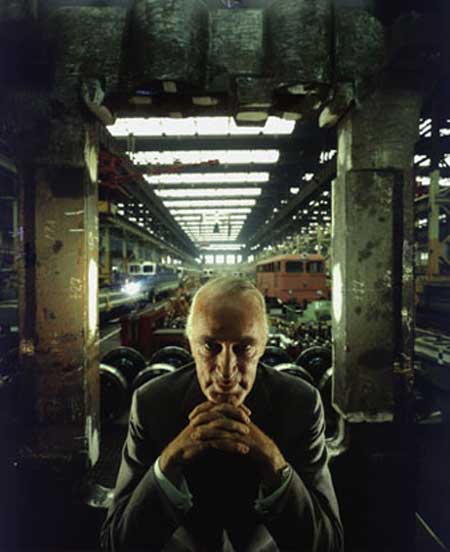
I was going through my old fashion portfolio and came across this shot of Ron Ames and thought is would make a good illustration for a second installment about classical portraits and single light setups.  I think it is always the case that that a classical style photographic portrait aims to emulate window light.  I this case, the "window" has Venetian blinds to add a little drama and mystery.  I found when I was lighting this shot that adding any additional lights or reflectors detracted from the overall graphic effect.


The lighting came from a single Broncolor flood/spot head in spot mode shown through blinds suspended from a boom arm.  Lighting from the left adds tension because is breaks from the convention established in painting.  The background is just white seamless paper. 

This picture is a digital copy of an 11x14 gelatin silver print made on the rich warm Agfa Portriga Rapid, which was partly bleached in potassium ferro-cyanide, then treated in Kodak Selenium Toner.  I always liked the blue/sepia split tone effect this processing yields.

Technical
Camera: Leica M2
Lens: Leica 90mm f/2.8 Tele-Elmarit-M
Exposure: Agfa Pan 400, f/5.6 @ 1/30s 
Lighting: Broncolor studio strobe
Support: Gitzo Studex Tripod with #2 Pan/Tilt head
Location: Globe Building Studio, St. Louis, MO
Dates: Capture - April 17, 1991, Processed April 17, 2011
Processing: Lightroom 3.3

Wednesday, April 6, 2011

Portrait Theory: The Psychological Portrait


Edward Steichen's 1903 photogravue of tycoon J.P. Morgan is frequently cited as a prime example of the psychological portrait, one that shows the inner man.  It is one of Steichen's most celebrated works.  The fierce expression, stiff posture and highlight on the chair arm looks at first glance like a  trench knife is thought by many critics to catch Morgan revealing himself as a sociopathic business man.  But is that the case?
I've been meaning for some time work through the general assertion that great portraits should all be a deep psychological study that reveals the soul or some deep inner truth about the subject.  This came to a head for me when my wife, Susan, read to me that John Updike, and others, criticized portraits by John Singer Seargent for "not being deep enough".  Irving Penn's portraits get a similar note, being called cool and distant.  What on earth could that mean?
In response to the idea of the phsychological portrait, I developed a thesis, which I found is not new or unique to my thinking, that a portrait cannot capture anything like the heart and soul of the subject.  In fact, I think the concept of the phychological portrait is fatuous.


My Exhibit A is this mug shot of actor Nick Nolte.  It has all the elements we associate with a psychological portrait.  We can see a man in apparent crisis, caught in a vulnerable moment, all pretense dropped.  There is a defiant resignation in his stare.  Would Sargent have painted a picture like this?  Highly unlikely.  Was the photographer seeking to capture the inner man?  Well, it is a mug shot, not a sitting for Vanity Fair.

Looking at examples critics hail as psychological portraits, they all seem to have these characteristics in common:
  • The picture is not flattering.  J.P. Morgan rejected his portrait.
  • The sitter must look fierce, uncomfortable, drunk, vulnerable and/or lecherous.
  • The more severe the "hatchet job" is on the sitter, the more celebrated the picture is as being "deep"
I really think any powerful portrait reveals more about the artist and viewer than it does the subject.  Penn and Sargent don't enter the sitter's world - they pull the subjects into theirs, without apology.

I'll close with a quote by one of my favorite portrait photographers:

"I am convinced that any photographic attempt to show the complete man is nonsense. We can only show, as best we can, what the outer man reveals. The inner man is seldom revealed to anyone, sometimes not even the man himself." - Arnold Newman

Sunday, March 13, 2011

Portrait Theory: Single Light


Photographic portraits that aim to emulate classical paintings are usually made with a single light source.  Complexity and nuance are enhanced by using flags and reflectors to shape the light.  This portrait of model Trisha Bradshaw was lit by a single Calumet Quattro beauty dish with a shower cap diffuser.

A new find for me, LightingDiagrams.com, provides an online tool for creating, you guessed it, lighting diagrams.  I thought I'd give it a try for this series.


The Quattro is angled to skim the gray ultra-suede background.  A mirror opposite the main light and behind Trisha creates the rim lighting.  A black foam core square behind Trisha flags the background and adds a geometric element.  The camera, a Nikon D700 and 105mm lens, is about six feet away, angled very slightly up.

Not that Trisha needs it, but this style of lighting has a slimming effect on the face because the shadow side is toward the camera and the rim light adds to the 3D illusion.

Saturday, March 12, 2011

Portrait Theory: Main Light

What do these portraits have in common?

Rembrandt self portrait

Rembrandt self portrait


Al Pacino by Irving Penn


Boy Bitten by a Lizard, Caravaggio


Gary Cooper by Edward Steichen


There are seveal common elements here. First, did you notice that the light souce is to the sitter's right? I recently read a study that claims more than 75% of portraits are made with the main light to the left of the subject. My own less formal browsing definitely agrees. Why is this?

One theory I find intriguing is that most painters, like the rest of the population, are right handed. If the main light is a window, then having the canvas lit from the left avoids a shadow cast by the painter's hand. Rembrandt used a mirror for his self portrait, so the mirror image geometry fits the theory, too. By the time photography was on the scene, portraits lit from the right looked the most natural. Subjects lit from the left seem to convey a different emotional impact due entirely to a convention dictated by 600 year old practical concerns.

Another thing to note is the the light source is broad, yet directional, as if coming from a window slightly higher than the subject. The nose shadow does not cross the lip line. The contrast from lit side to shadow side is fairly sharp, which helps delineate form and reinforce overall design.

So, a classical portrait has a main light with these characteristics:
  • The sitter is lit from the right
  • The light source is slightly higher than the subject
  • The light quality is fairly contrasty, like North window light
  • In gneral, the main light is the only light on the subject
  • The nose shadow never crosses the lip line
  • Highlights in the eyes are symmetrical
These are the main light "rules" to be broken, and of course, they frequently are with great success. The point point is that the classical main light rules yeild the most natural looking portraity. Moving the main to a different position usually introduces a new tension and increases drama. For instance, moving the main light high and to the left creates a new classic, the beauty shot, like this Ricard Avedon portrait of Liz Taylor:


Moving the light low and to the left is yet another classic I like to call "Frankenstein Light":


The position of the main light conveys a great deal of nuance, so it one the many tools available to the portrait photographer.

Portrait Theory: Lens Selection


After reading several articles in a row, like Ken Rockwell's March 2008 article, "Portrait Lenses", I found myself fearful that good information about classical photographic portrait technique technique is being drowned by voices high in search ranking but low on education and skill.  I belive that the classical foundations are critical to producing consistent, top caliber work.  It is easy to demonstrate that portrait masters like Irving PennYousef Karsh and Arnold Newman used the classical portrait techniques as the point of departure for their work.

What is the ideal classical portrait?  Like it or not, the ideal that challenges us all, even photographers, are paintings like Leonardo DaVinci's Mona Lisa.  I don't think it is a surprise that the most famous painting in the world is a portrait.  We are hard wired to recognize and appreciate every nuance of the human face.  Furthermore, we have the ability to detect even the slightest asymetry or distortion, ad adaptation that helps us choose healthy mates.  Classical portraiture, whether painting, sculpture or photography, aims at simultaneously capturing an accurate likeness and idealizing the sitter.  This balancing act is mastered by only a few artists in each generation, so it must be very difficult.  At least, there are rules of geometry that guide the way, which is the topic I plan to cover here in the next few posts.

So, the first order of business for a photographer is to choose a suitable portrait lens.  The rule of thumb criteria for this is well established and nothing like Rockwell's 15 foot theory.  Perspective is extremely important to making a pleasing portrait.  Perspective is determined by the camera to subject distance.  Most of use believe that the ideal camera to portrait subject distance to 5-7 feet and that the lens focal length should be twice normal focal length of the capture format, where the normal focal length is defined as the diagonal of the capture format.  For example, the full frame DSLR diagonal is 43mm.  Therefore, the ideal head and shoulders portrait focal length is 86mm.  It is therefore no surprise that Nikon, Canon, Zeiss and other lens makers offer several 85mm lenses that are tuned for portraiture.  Leitz is a bit of a maverick here.  First it set the standard normal focal length for the 24x36mm format to 50mm, a few millimeters longer than theoretcal.  Continuing the trend, 90mm is the Leica portrait standard, which it holds alone.

So, what does a classical portrait look like?  Simple, classical portrait of Ernest Hemmingway is the first Karsh I ever saw in person and the power of it is still impressive.  It was shot on 4x5 film using a 14" Kodak Ektar.  This is the image most of us have of Hemmingway.


What happens when a photographer deviates from the ideal?  Given a lens focal length that fills the frame with the head and shoulders, if the camera is too close, we get an unpleasant wide angle distortion, making th nose too large, forehead bulbous and ears recede.  Arnold Newman used just this technique as a deliberate hatchet job in his famous portrait of Alfried Krupp.  The classical foundation led him to choose the "wrong" lens to momentous effect.


So, keeping with the formual that 5-7 feet yeilds an ideal perspective, we have two common variants; full lenght and extreme close-up.  To accomplish a full length shot, a normal lens is in order.   For instance, the portrait below or Max Ernst and Dorthea Tanning by Irving Penn was made on 8x10 film using a Schneider 300mm.


Finally, the extreme close up, which can be very powerful, but seldom flattering.  Irving Penn used a normal 80mm lens on his Rolleiflex to shoot Truman Capote.  The wider than normal perspective slightly emphasizes Capote's hands and eyeglasses.


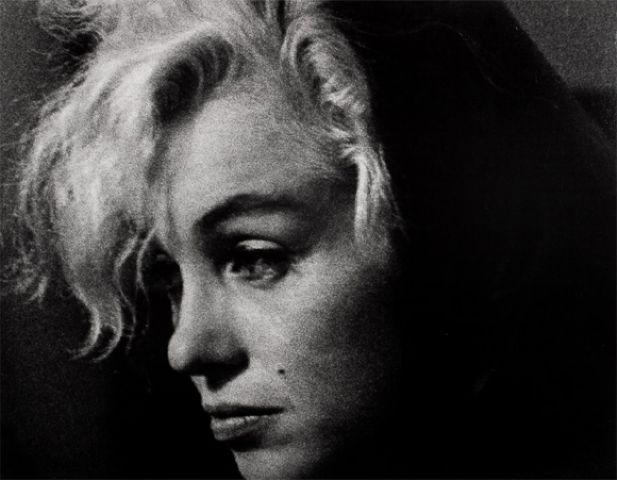
Whereas Arnold Newman used a Leica with a 135mm lens to capture Marilyn Monroe, achieving a voyeuristic mood.  We feel like we are intruding on a private moment.


Most readers of this blog shoot a DSLR, so the table below shows the focal length recommendation for the Nikon FX and DX formats.

FX
(24mm X 36mm)
DX
(23.7mm x 15.5mm)
“Voyeur” Effect 135mm 85mm
Full Frame Head 105mm 70mm
Classical Portrait 85mm 60mm
Medium 60mm 50mm
Full Length 50mm 35mm